RV Black Tank Maintenance: The Complete System Guide (2026)
Affiliate Disclosure: RVRated’s analysis is based solely on technical specifications and aggregated owner review data. This site may earn a commission on qualifying purchases.
RV Black Tank Maintenance: The Complete System Guide (2026)
Nothing in an RV triggers more anxiety than the black tank.
Horror stories circulate: persistent odors, failing sensors, jammed dump valves, toilet backups, the infamous poop pyramid.
But rv black tank maintenance isn’t complicated. Nearly every serious problem traces back to a preventable mistake.
Understand the system and you turn black tank care from a headache into routine.
This rv black tank guide covers the entire system: how the tank works, dump timing, water use, high-impact maintenance habits, odor and clog prevention, tank treatment selection, and costly mistakes to avoid.
Quick Reference: The Entire RV Black Tank System in One View
The Complete Maintenance Cycle
Every recommendation in this guide reinforces some part of that cycle.
Understanding Your RV Black Tank System Architecture
The black tank is a sealed holding tank designed to store wastewater from the RV toilet. Unlike a residential sewer system, waste does not continuously flow away. Everything remains inside the tank until the owner dumps it.
Good rv black tank care starts with understanding what the system actually is. The rv black tank system consists of: toilet, black holding tank, roof vent, tank sensors, dump valve, and sewer connection.
Knowing how to maintain rv black tank performance means treating these components as a connected system — not just the tank in isolation.
Most new owners miss this: water — not gravity — moves waste. Gravity doesn’t get waste out. Water does. Not enough water is the root cause of most black tank issues.
The Core RV Black Tank Maintenance Routine: Step by Step
Follow this sequence after every dump. Skip a step and the system degrades.
Add 1–3 gallons immediately after dumping. Creates a liquid base layer so solids never hit dry tank floor.
Hold pedal 5–10 seconds. Water is the transport mechanism — not gravity. Chronic low-water flushing = clogs.
Odor control + waste breakdown + sensor protection. Enzyme or bacteria-based, formaldehyde-free.
Always closed except when dumping. Open valve = liquids escape, solids stay = pyramid plug. #1 mistake.
Wait until at least 2/3 full. Larger water volume = stronger flush = cleaner dump.
Rinse 20–30 min after every 3–5 dumps. Removes residual waste, protects sensors, resets the cycle.
⚠️ Critical: The black tank valve must remain closed at all times except during active dumping. This single rule prevents more severe clogs than any other practice.
These rv black tank tips apply whether you’re a weekend camper or a full-timer — consistent rv holding tank maintenance prevents the problems that catch most owners off guard.
Critical Chemical and Odor Control: The Treatment Guide
Tank treatment selection trips up many owners. Not all treatments do the same job.
Use RV-specific tank treatments. Skip household chemicals like bleach or dish soap — especially Dawn, which causes high suds and foaming in black tanks. Top manufacturers (Thetford, Camco) explicitly warn against household cleaners. Stay with products engineered for RV holding tanks.
Understanding the Camco TST Product Family
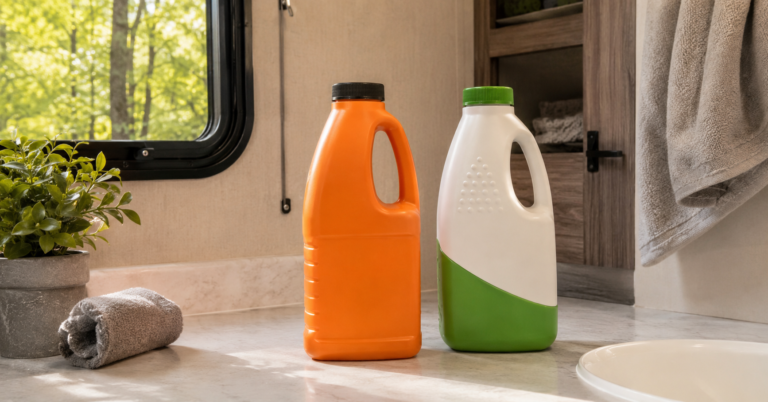
Camco’s TST lineup confuses new buyers. Orange vs. Blue is the main comparison — distinctions are scent, heat performance, and format. Summer camping pushes these differences to the forefront as odor management gets tougher in heat.
Camco vs Thetford: Two Different Philosophies
This isn’t just odor control. It’s a difference in philosophy: Camco leans on concentrated chemistry; Thetford on environmental compliance. AquaMAX is 100% formaldehyde-free and California-approved.
Preventing Catastrophic Clogs and Blockages
Odors are an inconvenience. Clogs are a repair bill. Knowing how clogs form is a core skill for any RV owner.
The RV Poop Pyramid Problem
One of the most common severe black tank failures is the pyramid plug — also called the rv poop pyramid. It forms when solids accumulate beneath the toilet opening and harden into a cone-shaped mass.
Most pyramid plugs happen when the black tank valve stays open at full hookup. Liquids drain, solids linger, waste dries and compacts. Prevent it by closing the valve. Simple.
Toilet Paper and Clog Prevention
Toilet paper is a divisive topic. The label doesn’t matter — breakdown speed inside the tank does.
Experienced owners often pick thin, single-ply papers like Scott 1000. They avoid thick, super-absorbent types built to stay strong when wet. Those papers leave less margin for error, especially for minimal water users.
Seasonal and Long-Term Tank Care
Summer Maintenance
Heat ramps up odor. In summer, monitor odors, stay consistent with treatments, use enough water, and dump before tanks get too concentrated.
Winter Storage
Before storage: empty, rinse, and winterize the black tank for your climate. Skip it, and leftover waste will greet you later.
Long-Term Sensor Accuracy
False tank readings are routine. Most are caused by waste buildup, not broken sensors. Regular rinsing and good habits keep readings accurate longer.
Common Black Tank Mistakes to Eliminate
❌ Leaving the Valve Open
The number one mistake. Open valve at hookup = solids accumulate = pyramid plug.
❌ Using Too Little Water
Water is the foundation of the system. Chronic under-flushing causes most clogs.
❌ Dumping Too Frequently
Don’t dump until 2/3 full. More liquid = better flush.
❌ Ignoring Odors
New odors usually mean maintenance is slipping.
❌ Using Household Chemicals
Dawn, bleach, and household cleaners cause foaming and damage. RV-specific treatments only.
❌ Treating Chemicals as Magic
Tank treatments help. They’re no substitute for proper tank management.
Print, laminate, and keep in your RV utility compartment.
Frequently Asked Questions
Complete RV Black Tank Resource Center
For deeper dives into specific topics:
These articles make up the full RVRated RV bathroom maintenance system.
Sources
- Thetford — 32327 Holding Tank User Manual (Official) — manuals.plus
- Thetford — RV Tank Treatments Product Catalog — thetford.com
- Simple Green — RV Black Water Tank Treatment & Maintenance Guide — simplegreen.com
- Delta RV — The Ultimate Guide to RV Black Water Tank Treatment and Care — deltaliquidenergy.com
- Walex Products — How to Clean and Maintain RV Black Tank Sensors — walex.com
- RV Flush Guide — RV Toilet Paper vs Regular: 7 Safe Rules For RV Owners — rvflushguide.com
- National RV Training Academy — Do You Really Need RV-Specific Toilet Paper? — nrvta.com
- Kleen Tank — Dawn in Your RV Waste Tanks: Good Idea or Bad? — kleentank.com
Affiliate Disclosure: RVRated’s analysis is based solely on technical specifications and aggregated owner review data. This site may earn a commission on qualifying purchases.