Camco TastePURE vs. Clear2O: What We Found in Owner Reviews
What the Camco TastePURE vs Clear2O RV Water Filter Comparison Actually Reveals
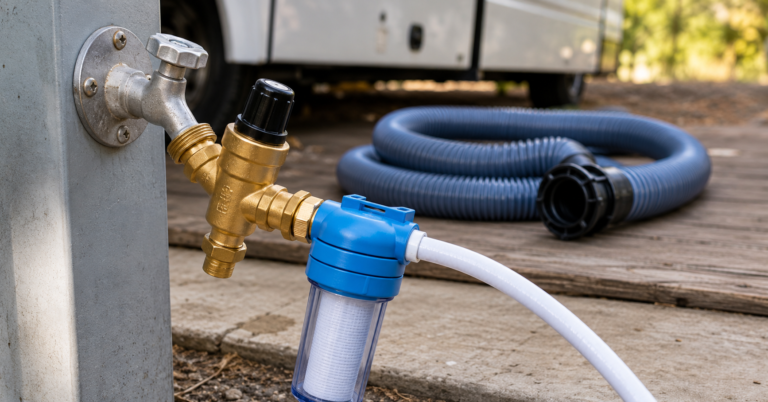
An inline RV water filter connects between the campground water source and the RV’s plumbing system. Its job is to reduce contaminants that affect taste, odor, and water quality before water reaches faucets, showers, water heaters, and appliances.
The micron rating is the most important specification to understand. Smaller micron ratings capture smaller particles — but finer filtration typically comes with trade-offs in flow rate, clog resistance, and filter life under challenging water conditions.
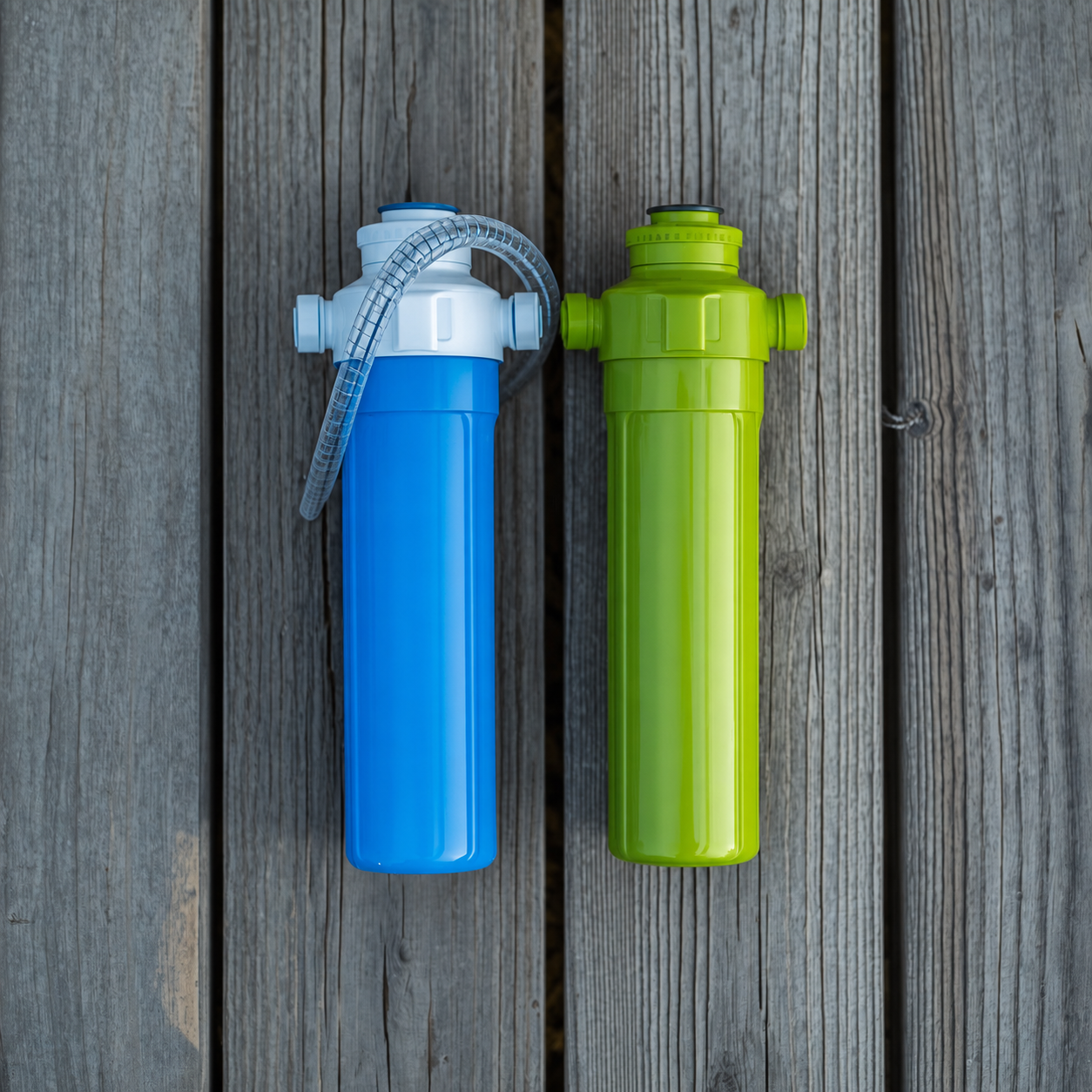
The Camco TastePURE 40043 uses a granular activated carbon (GAC) system combined with a KDF layer, rated at 20 microns. The design prioritizes consistent performance across a wide range of campground water conditions.
The Clear2O CRV2006 uses a solid carbon block rated at 1 micron — 20 times finer than the TastePURE. That density is what allows it to remove sulfur and capture smaller contaminants. It also carries a higher clog risk in sediment-heavy water.
The data indicates these two filters are solving slightly different problems — which is why owner satisfaction stays relatively high for both despite the performance differences.
Head-to-Head: The Best RV Inline Water Filter Specs That Matter
The specifications reveal two different design priorities. Here is what the verified data shows for each model.
| Specification | Camco TastePURE (40043) | Clear2O (CRV2006) |
|---|---|---|
| Filtration type | GAC granular + KDF | Solid carbon block |
| Micron rating | 20 microns Some older comparison charts cite 100 microns — current US model is 20 microns per manufacturer product guide. | 1 micron Deeper |
| Flow rate | 2.5 GPM @ 20–125 psi | 3.5 GPM @ 50 psi Higher Spec flow rate. Real-world flow decreases as filter loads with sediment. |
| Filter life | ~3 months / 500 gal | 3–6 months (varies by water quality) |
| NSF certifications | 42, 53, 372 +Lead | 42, 53 |
| Sulfur / H₂S removal | ✗ No | ✓ Yes Key diff |
| Bacteria control | ✓ Yes (KDF layer) KDF | ✗ Not stated |
| Clog risk (high sediment) | ✓ Low Safer | High without pre-filter |
| Price (single unit) | ~$17–22 | ~$18–25 |
| Hose protector included | ✓ Yes Included | ✗ No |
| Review base (Amazon) | ~50,000 / 4.5★ Proven | Brand avg 4.3★ |
What 1,500+ Owners Report
Patterns from owner reviews remain consistent across Amazon, RV forums, and campground communities.
TastePURE Owners Say
TastePURE owners consistently highlight reliability and availability as the product’s core strengths. Many reviews reference multiple seasons of use across thousands of travel miles without issues. Replacement filters are available through Amazon, Walmart, Camping World, Home Depot, and most sporting goods stores — which matters when a filter fails mid-trip.
The KDF layer draws specific praise from owners who store the RV for extended periods, as it actively prevents mold and bacteria growth inside the filter when not in use.
The most common criticism is sulfur odor. Owner reviews repeatedly note that the TastePURE does not eliminate the rotten egg smell associated with well water or sulfur-rich campground sources. In those situations, buyers begin looking at alternatives.
Isolated reviews mention plastic thread damage from overtightening — infrequent relative to the overall review volume but consistent enough to be a documented pattern.
Clear2O Owners Say
Clear2O reviews center on filtration quality and sulfur removal. Buyers dealing with well water or campground hookups producing a rotten egg odor regularly report meaningful improvement after switching to the CRV2006. This is the filter’s most cited advantage and its clearest differentiation from the TastePURE.
The 1-micron carbon block appeals to buyers who want finer filtration confidence at the point of entry. Many reviews mention improved taste compared with standard GAC filters.
Clogging is the documented weak spot. High-sediment water chokes flow — reviews and forums report it consistently. Clear2O’s own FAQ acknowledges that water conditions significantly affect filter life, and the brand recommends a sediment pre-filter for high-particulate sources.
Experienced owners frequently pair the Clear2O with a sediment pre-filter and an RV water pressure regulator for best results.
The Flow Rate Trade-Off: What the Data Shows
On paper, the Clear2O CRV2006 carries a higher rated flow than the TastePURE: 3.5 GPM at 50 psi versus the TastePURE’s 2.5 GPM. That gap reflects a design choice, not a quality difference.
The TastePURE’s lower rated flow comes from its wide-body GAC design — a format optimized for consistent output across varying campground pressures (rated 20–125 psi), not peak throughput under lab conditions.
The Clear2O’s 3.5 GPM spec is measured at 50 psi, which sits in the middle of the typical campground range of 40–60 psi. Under real-world conditions, actual flow decreases as the 1-micron carbon block accumulates sediment — a known characteristic of solid block filters at this micron level. Clear2O itself notes that the 5-micron CRV1005 delivers approximately 50% more flow than the CRV2006, which signals how much the 1-micron block affects throughput relative to coarser designs.
The data indicates that flow rate alone does not determine which filter performs better day-to-day. The more relevant question is whether the campground water source contains sediment levels that will accelerate clogging in a 1-micron block — and whether the sulfur removal capability of the Clear2O justifies that trade-off for that specific owner’s travel pattern.
When TastePURE Wins — When Clear2O Wins
TastePURE makes the most sense for owners who camp primarily at established campgrounds on municipal water. The combination of bacteria control via KDF, low clog risk, broad retail availability, and a review base exceeding 50,000 ratings makes it the lower-risk choice for everyday use.
It is also easier to maintain. The 20-micron GAC design shrugs off variable water quality — no surprise clogs like the 1-micron block introduces. For full-time RVers who move through multiple campgrounds monthly, that consistency matters.
Clear2O becomes the stronger choice when water quality is unpredictable or sulfur is present. Owners boondocking on well water, camping at locations with known hydrogen sulfide issues, or building a multi-stage filtration setup report the greatest benefit. When paired with a sediment pre-filter and pressure regulator, the CRV2006’s documented weaknesses become significantly less relevant.
In short: TastePURE wins on reliability and simplicity across diverse campground conditions. Clear2O wins when filtration depth and sulfur removal are the primary requirements.
Which RV Water Filter Is Right For You?
- Camping at established campgrounds with municipal water
- Full-time RV living — consistency matters more than peak filtration
- You need replacement filters available at stores on the road
- Budget is a priority — strong 2-pack value
- You use a separate drinking water filter inside the RV
- Your campground water has sulfur / rotten egg odor
- Boondocking on well water or unknown sources
- You want 1-micron filtration at the point of entry
- You’re willing to pair it with a sediment pre-filter
- Filter longevity matters more than clog resistance
The Data Verdict
For the majority of RV owners camping at established campgrounds, the data supports the Camco TastePURE. Its combination of bacteria control, low clog risk, proven review base, and broad availability makes it the practical choice for day-to-day use.
The answer changes when sulfur odor or finer filtration enters the picture. The Clear2O CRV2006’s 1-micron solid carbon block provides capabilities — particularly hydrogen sulfide removal — that the TastePURE’s GAC design was not built to deliver.
For buyers building a complete water filtration setup, these filters are not rivals — each fills a different position in the system.
For a complete overview of RV water filters, pressure regulators, hoses, and sanitation equipment, see our RV water and sanitation setup guide.
Frequently Asked Questions
How long does the Camco TastePURE last compared to the Clear2O?
The Camco TastePURE 40043 is rated for up to 3 months or 500 gallons under normal municipal water conditions. The Clear2O CRV2006 is rated for 3 to 6 months. However, the Clear2O’s 1-micron carbon block will clog significantly faster than the 20-micron TastePURE at campgrounds with high sediment or mineral content — unless paired with a sediment pre-filter.
Does the Clear2O reduce TDS (Total Dissolved Solids)?
No. Neither the Clear2O CRV2006 nor the Camco TastePURE reduces Total Dissolved Solids. Both filters target chlorine, sediment, bad taste, odors, and volatile organic compounds. TDS reduction requires reverse osmosis or distillation — neither of which these inline filters provide.
Can you safely drink campground water using just these inline filters?
If the campground water source is designated as potable by local health authorities, both filters are effective at improving taste and odor. Neither unit is a water purifier — they cannot neutralize viruses or biological cysts from unmanaged or contaminated water sources. For drinking water from unknown sources, a UV purifier or RO system is required in addition to an inline filter.
📋 Sources & References
Camco TastePURE 40043 — Official & Retailer
- Amazon Product Page — Camco TastePURE 40043 [Retailer]
- Walmart Product Page [Retailer]
- Camping World Product Page [Retailer]
- Camco Marine-J Product Guide PDF (2021) — flow rate 2.5 GPM confirmed [Manufacturer]
Clear2O CRV2006 — Official & Retailer
- Clear2O Official FAQ — CRV2006 flow rate 3.5 GPM @ 50 psi confirmed [Manufacturer]
- Amazon Product Page — Clear2O CRV2006 [Retailer]
- Walmart Product Page [Retailer]
Owner Review Data & Independent Analysis
- The RV Atlas — TastePURE review base (~50,000 reviews, 4.5★)
- Our Campfire Unplugged — Multi-filter field comparison (Dec 2025)
- Thor Forums — Clear2O CRV2006 owner discussion
- 1,500+ verified Amazon owner reviews analyzed across both models
Water filtration is one part of a complete RV water setup. For a comparison of the top RV sewer hose options, see our full breakdown of RhinoFLEX vs. Viper.
RVRated’s analysis is based solely on technical specifications and aggregated owner review data. This site may earn a commission on qualifying purchases.